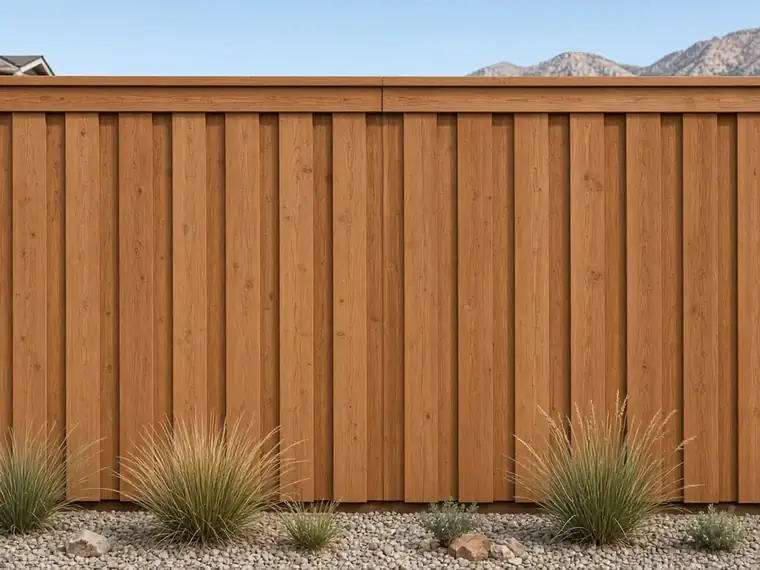
Why wood is still the default backyard fence
Wood gives full privacy at the 6-foot height Denver allows behind the primary façade, it's easy to repair one board or section at a time, and it fits nearly every neighborhood's look. Cedar is popular because it is naturally rot-resistant and stays straighter than many softwoods. Pressure-treated posts are often paired with cedar pickets because posts are the part in contact with soil.
How Denver's climate treats a wood fence
- Sun and dry air. At a mile high, unprotected wood greys and checks (small surface cracks) faster than in humid places. A penetrating stain or sealer slows that down; ask each contractor whether finish is included and how often they expect it to be redone.
- Wind. A solid 6-foot fence acts like a sail. Post spacing, post size and how rails attach matter more than board thickness. Ask what post size and spacing the quote assumes.
- Expansive clay. The Colorado Geological Survey notes that swelling clays can expand up to 20% by volume when wet (CGS). Wet clay against a post footing can lift it. Gravel at the base of the hole, a crowned concrete top that sheds water, and keeping sprinkler spray off the fence line all help.
- Freeze-thaw. The adopted 2025 Denver Building Code (§1809.5) and 2025 Denver Residential Code (Table R301.2) set a 36-inch frost line depth for building footings. Fence posts aren't held to that number, but it's the local yardstick when one quote sets posts shallower than another.
Height and permits for wood fences
In the City and County of Denver a 6-foot wood fence must sit behind the primary street-facing façade, at least 6 inches from the public sidewalk, and fully on your property. Because it is taller than 4 feet it needs a zoning permit. A post-hole-dug wood fence only needs a building permit if it is taller than 8 feet (Denver CPD). In front of the house, a wood picket or rail fence is limited to 4 feet.
Suburbs differ: Aurora doesn't require a permit for wood, privacy, picket or rail fences, while Arvada and Littleton require one for every fence. See your city.
Styles that work within the rules
- Dog-ear or flat-top privacy for rear and side yards up to 6 feet.
- Board-on-board (overlapping pickets) for privacy that stays covered as boards shrink in dry air.
- Horizontal slat modern fences; ask about mid-span support so long boards don't sag.
- Picket or split rail for front yards, where Denver caps height at 4 feet and nearby cities such as Lakewood and Littleton also require the fence to be at least 50% open.
What drives the price
Angi's 2026 Denver data puts basic wood fencing at $9–$27/ft ($3,312 average) and 6-foot privacy fencing at $10–$55/ft ($2,860 average for 150 feet of wood privacy; cedar upgrades and custom horizontal boards run toward the upper half). Use the Denver Fence Cost Calculator to price your exact footage, gates, removal and slope, then compare bids line by line.
Questions to ask a wood fence contractor
- Who applies for the zoning permit, and is the fee in the quote?
- Who files the Colorado 811 locate, and who finds private lines such as sprinklers?
- Post material, size, spacing and depth?
- Is stain or sealer included, and what product?
- Which side faces the neighbor or street, and is the survey or property line confirmed?
- What is the written workmanship warranty?
Frequently asked questions
How tall can a wood privacy fence be in Denver?
Up to 6 feet behind the primary street-facing façade and 4 feet in front of it, outside industrial zones. Staff can approve up to 2 feet more for over-height fences that meet set criteria, often requiring the extra height to be at least 50% open.
Is cedar worth it over pine in Denver?
Cedar resists rot and stays straighter, which helps in dry, high-UV air. Many installers pair cedar pickets with pressure-treated posts rated for ground contact. Compare quotes on the same post and picket materials to see the real difference.
How often should a cedar fence be sealed in Denver?
There's no single schedule. Sun exposure, product and fence orientation all change it. South- and west-facing runs weather fastest. Ask your contractor which product they use and what re-coat interval its maker recommends.
Why do fence posts lean in Denver?
Common causes are expansive clay lifting the footing, water pooling at the post base, wind load on solid panels, and rot at the soil line. See our repair page for how each is fixed.
Do I need a permit to replace my wood fence in Denver?
If the new fence is over 4 feet, Denver requires a zoning permit. In a historic district, landmark property or along a designated parkway, any fence needs a permit. Check with Denver Residential Permitting before tearing out the old fence.
Can I build a wood fence right on the property line?
Denver says fences must not be built on a neighbor's property or in the public right-of-way, and must sit at least 6 inches from the public sidewalk. If the line isn't certain, a private survey is the reliable way to confirm it.
Which side of the fence faces out?
Denver's fence page doesn't set this, but Arvada requires the finished side to face public rights-of-way, including trails. Many HOAs specify it too. Check your HOA rules and agree on it in writing.