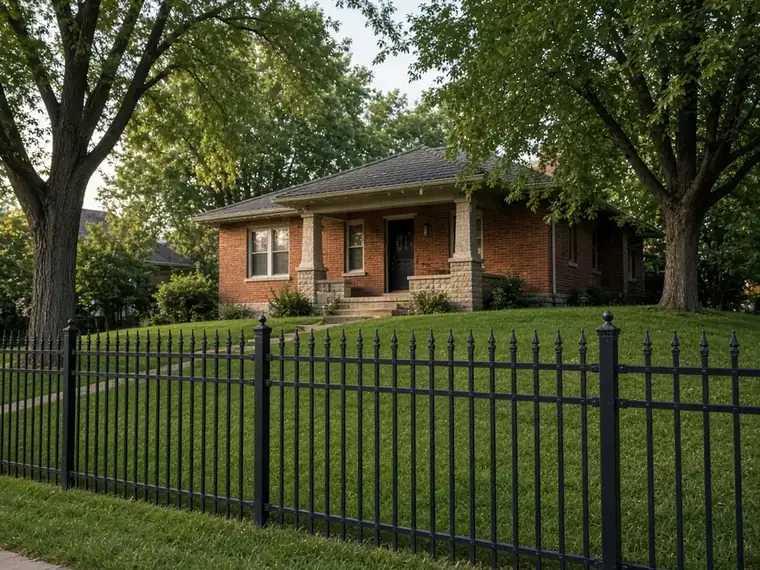
Why metal works in front yards
Several metro cities require front fences to be mostly open:
- Denver historic districts and landmarks: front-yard fences up to 4 feet and more than 50% open (Denver Landmark Preservation).
- Lakewood: front fences up to 4 feet and at least 50% open (Lakewood).
- Littleton: front fences up to 48 inches; at least 50% open on interior lots and 75% open on corner lots (Littleton).
- Aurora: front fences up to 42 inches and no more than 50% opaque (Aurora).
- Arvada: most residential front setbacks allow 3 feet, rising to 4 feet if at least 50% transparent (Arvada).
Picket-style iron, steel or aluminum clears those openness tests easily, and Denver's over-height rule also requires extra height to be at least 50% open in certain front locations.
Iron, steel or aluminum?
- Wrought iron / steel: heaviest and strongest, can be custom-fabricated to match older Denver homes. Needs paint touch-up where coating chips, or rust starts.
- Powder-coated aluminum: lighter, won't rust, usually sold in standard panel heights. Good for pools and long runs.
- Steel panels with powder coat: a middle option that's stiffer than aluminum.
Pool fences
Pool barriers carry their own rules. Littleton, for example, requires residential pools 24 inches or deeper to be fully enclosed by a fence at least 48 inches tall built to prevent entry (Littleton). Confirm the current barrier rules with your city's building department before the fence is ordered, because gate hardware and picket spacing are part of compliance.
Historic homes
In Denver's historic districts, any fence needs a permit and a Landmark Certificate of Appropriateness. Open metal or wood designs that match the period of the house are the usual route. Some fence projects qualify for Landmark quick review, which Denver says is typically processed within a few business days of a complete application. See historic districts and parkways.
What drives the price
Material (custom iron vs. stock aluminum), height, picket style, linear footage, gates (especially driveway gates and automation), mounting on a wall vs. in-ground posts, slope, and permit/Landmark review.
Frequently asked questions
How tall can a front yard metal fence be in Denver?
4 feet in front of the primary street-facing façade, outside industrial zones. In historic districts the front fence must also be more than 50% open. Over-height requests are possible within limits but need city approval.
Is aluminum or iron better for Denver?
Aluminum won't rust and needs little upkeep; iron or steel is stronger and better for custom work on older homes but needs touch-up paint where the finish chips. Both meet front-yard openness rules.
Does a pool fence in the Denver area need to be 4 feet?
Littleton, for example, requires a fence of at least 48 inches around residential pools 24 inches or deeper. Barrier rules also cover gates and openings, so confirm the current requirements with your city's building department before ordering.
Can I put a metal fence on top of a retaining wall in Denver?
Possibly, but Denver treats walls over 12 inches as needing a zoning permit, and mixed fence-on-wall designs need elevation drawings with the application. The combined height counts against limits, so plan it with the permit in mind.
Are metal fences allowed in Denver historic districts?
Open metal fences are generally compatible, but every fence in a historic district needs a permit and Landmark review. Front fences must stay at or below 4 feet and more than 50% open.
Do metal fences need a permit in Denver?
Yes if over 4 feet, and always in historic districts, on landmarks and along designated parkways. Masonry and retaining walls over six feet need engineering review and a building permit.
Do ornamental fences help with privacy?
Not much; they're designed to be open. Many homeowners use metal in front, where openness rules apply, and wood or vinyl privacy fencing behind the house.