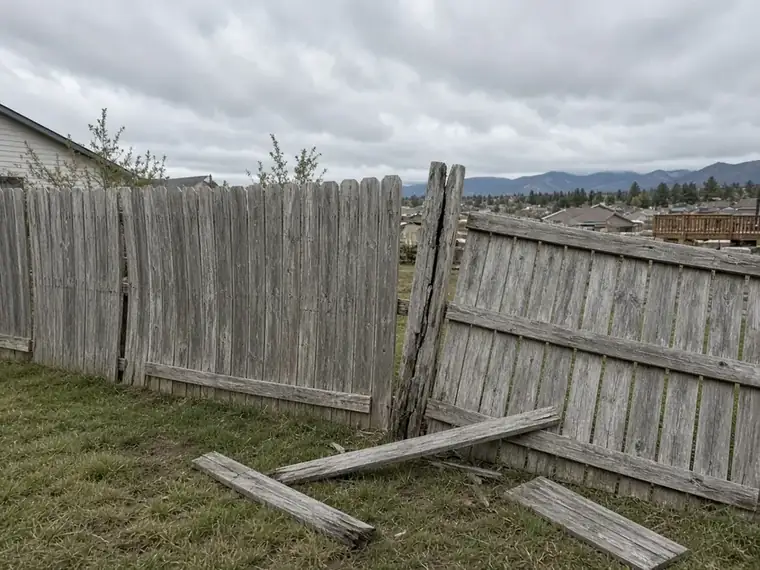
Common problems and what usually fixes them
| Problem | Likely cause | Typical fix |
|---|---|---|
| Posts leaning or lifted | Swelling clay, water at the footing, wind load | Reset or replace posts with better drainage; add bracing or sister posts |
| Post snapped at ground level | Rot where wood meets soil or concrete | Replace post; consider a steel post or post bracket |
| Panels blown out | Wind on a solid fence, weak rail fasteners | Re-fasten or replace rails; check post spacing |
| Gate sags or won't latch | Gate post movement, hinge wear, no diagonal brace | Re-set gate post, add anti-sag kit or brace, new hinges |
| Grey, cracked boards | UV and dry air | Replace worst boards, clean and seal |
The Colorado Geological Survey describes swelling clays that can expand up to 20% by volume when wet and exert large forces on anything that confines them (CGS). Fence posts are light, so they move first. A repair that just re-sets a post in the same wet spot often fails again; ask how the contractor will manage water at the footing.
When a repair needs a permit
- Denver: permits are triggered by height (over 4 feet) and location (historic districts, landmarks, parkways), not by repair length (Denver CPD). Replacing a 6-foot fence is building a fence over 4 feet, so plan on a zoning permit.
- Lakewood: a permit once more than 8 linear feet of fencing is replaced, repaired, modified or built (Lakewood).
- Arvada: every fence needs a permit except repair of a section no more than 8 linear feet (Arvada).
- Centennial: replacement needs a permit when height, location or materials change, for example chain link to wood (Centennial).
- Littleton: all fences require a building permit (Littleton).
- Aurora: no fence permit for new or replacement fences, but city standards still apply (Aurora).
Repair or replace?
Replacement usually makes sense when many posts are failing, the fence is past the height or setback rules you want, or matching boards and panels is no longer realistic. A full replacement is also the moment to fix placement. Denver requires fences to be on your property, out of the right-of-way and at least 6 inches back from the public sidewalk.
Storm and hail damage
If a storm damaged the fence, photograph it before cleanup and check your homeowner's policy. Ask the contractor for an itemized written estimate you can send to your insurer. We don't make claims about coverage; your policy decides that.
Digging for new posts
Resetting or adding posts is digging. Colorado law requires a Colorado 811 request at least two full business days before excavation (not counting the day you notify), and Colorado 811 says to wait at least three full business days and check the ticket status. Private lines, including sprinkler lines, aren't marked by 811; Colorado 811 puts private locating at roughly $100 to $350 on average (Colorado 811).
Frequently asked questions
Why does my fence lean after a wet spring?
Swelling clay and water at the footing are common causes in the Denver area. Clay expands when wet and can lift or tip posts. Fixes include resetting posts with gravel drainage, shaping concrete to shed water, and moving sprinkler spray off the fence.
Do I need a permit to repair my fence in Lakewood?
Lakewood requires a fence permit if more than 8 linear feet of fencing is replaced, repaired, modified or constructed. Smaller repairs don't trigger it. Apply through eTRAKiT or the Lakewood permit counter.
Do I need a permit to fix a fence in Denver?
Denver's permit triggers are height over 4 feet and special locations like historic districts, landmarks and parkways. Replacing a 6-foot fence typically means a zoning permit. Small board or hardware repairs generally don't.
Do I have to call 811 to replace one fence post?
Yes. Colorado 811 says all property owners must request a locate before any excavation, and lists digging fence holes as an example. Submit at least two full business days ahead, not counting the day you notify.
How do I fix a sagging gate?
First check whether the gate post has moved. If so, the post needs re-setting or bracing. Otherwise an anti-sag cable kit, a diagonal brace or new heavy-duty hinges usually solves it.
Can I replace a fence with a different material in Centennial without a permit?
No. Centennial requires a permit for replacements where height, location or materials change, for example chain link to wood. Like-for-like replacement of a properly permitted fence generally doesn't need one.
Should I repair or replace a fence damaged by hail or wind?
If damage is limited to a few boards, panels or one post, repair is usually sensible. If many posts are failing or the fence doesn't meet the height you want, replacement may be better. Get an itemized estimate either way.