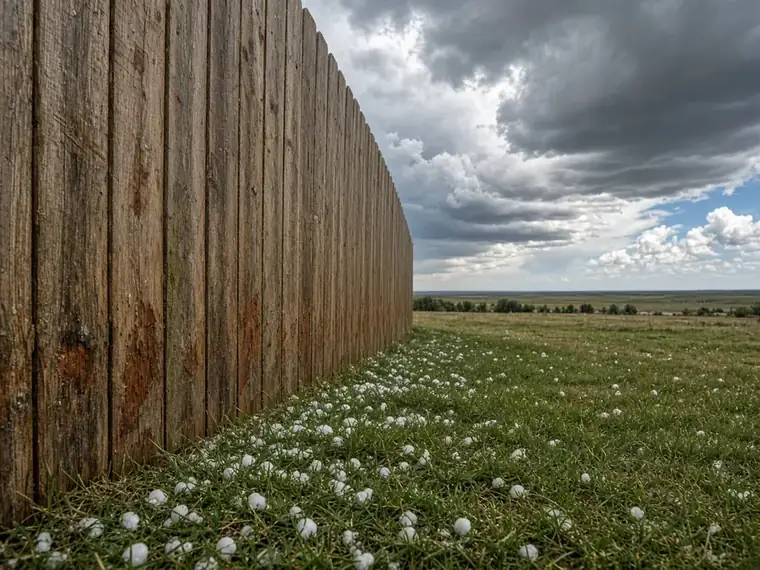
What Colorado throws at a fence
- Hail. Colorado's Front Range sits in "Hail Alley." The state's emergency management office, citing the Rocky Mountain Insurance Information Association, says the damaging hail season runs mid-April to mid-September and the state usually sees three or four catastrophic hailstorms a year (Colorado DHSEM).
- Expansive soil. The Colorado Geological Survey calls expansive soil the state's most significant geologic hazard; some clays swell by up to 20% by volume when wet (CGS). That's what lifts and tilts fence posts.
- Freeze-thaw. The adopted 2025 Denver Building Code (§1809.5) and 2025 Denver Residential Code (Table R301.2) set a 36-inch frost line depth for building footings. Fence posts aren't held to it, but it's the official yardstick when comparing post depths.
- Sun and dry air. At a mile high, wood dries and grays quickly and finishes fade faster than in humid climates.
Material by material
Cedar and other wood
The most common privacy fence in the metro, and the material many HOAs specify. Cedar resists rot better than untreated pine, but in dry, sunny air boards check, cup and gray unless they're sealed or stained on a schedule. HomeAdvisor puts wood's useful life at five to ten good years before it needs serious attention (HomeAdvisor). Board-on-board styles keep privacy as boards shrink. Hail dents soft wood but rarely ruins it. More on cedar and wood fences.
Vinyl
Very little upkeep and no staining. HomeAdvisor cites a 20- to 30-year life, but also says vinyl isn't ideal in extreme climates, so ask about the product's cold-weather impact rating and wall thickness, and how panels are held against wind. Some Denver historic districts and many HOAs don't allow it. More on vinyl fences.
Chain link
Shrugs off hail and wind because air passes through it. Galvanized or vinyl-coated mesh resists rust in a dry climate. It gives no privacy, and Denver historic districts, Greenwood Village front yards and many HOAs restrict it. More on chain link.
Aluminum and steel
Open ornamental styles that work with front-yard openness limits and pool barriers. HomeAdvisor says aluminum can last up to 50 years and resists corrosion; steel is stronger but needs its coating kept intact to avoid rust. Wind passes through, and hail rarely matters. More on ornamental metal.
Composite
Wood-look boards with low upkeep. Ask how the product handles UV fading and heat expansion, and check your HOA allows it.
Quick comparison
| Material | Hail | Wind | Upkeep in dry sun | Common restrictions |
|---|---|---|---|---|
| Cedar / wood | Dents, rarely fails | Solid panels catch wind; post depth matters | Seal or stain on a schedule | HOAs may require specific designs and stain |
| Vinyl | Ask about impact rating | Solid panels catch wind | Wash only | Historic districts, some HOAs |
| Chain link | Very good | Very good | Minimal | Front yards, historic districts, HOAs |
| Aluminum / steel | Very good | Very good | Touch up coating | Few; often preferred in front yards |
Comparison is general guidance drawn from the sources above, not a test result. Manufacturer specs and warranties vary by product.
Post setting is the real weather test
Whatever the material, most Front Range fence failures start at the posts: heaving in clay, rot at the soil line, or concrete that holds water. Ask each contractor how deep they set posts, whether they use gravel at the bottom of the hole, how they crown the concrete to shed water, and how they keep sprinkler spray off the posts.
After a hailstorm
Photograph damage before cleanup. Many Colorado homeowner policies have a separate wind/hail deductible that's a percentage of coverage, so check your declarations page (Colorado Division of Insurance). The Division of Insurance also warns about door-to-door storm contractors: check references and get everything in writing.
Fire-hardened materials and HOAs
Colorado's HB24-1091 limits how far an HOA can prohibit fire-hardened fencing materials. If you want metal or another non-combustible fence and your HOA pushes back, read our HOA approval guide.
Frequently asked questions
What is the best fence material for Colorado hail?
Open metal fences and chain link fare best because hail and wind pass through. Cedar dents but rarely fails. Vinyl varies by product, so ask for the impact rating.
Does vinyl fencing crack in Colorado winters?
It can, depending on the product. HomeAdvisor notes vinyl isn't ideal in extreme climates. Ask about cold-weather impact resistance and wall thickness, and how the panels are anchored against wind.
How often should I stain a cedar fence in Denver?
There's no fixed schedule. Dry air and strong sun weather wood quickly, so check it each spring and reseal when water no longer beads on the boards. Follow the stain maker's directions.
Why do fence posts lean in Denver?
Expansive clay soils swell when wet and shrink when dry, pushing posts out of plumb. Water from sprinklers or downspouts against the posts makes it worse.
How deep should fence posts be in Denver?
Code doesn't set a fence post depth, but the 2025 Denver Building Code (§1809.5) and 2025 Denver Residential Code (Table R301.2) specify a 36-inch frost line depth for footings—a useful benchmark when comparing contractor post depths.
Will my HOA let me use a metal fence?
Many will, and Colorado's HB24-1091 limits how far an HOA can prohibit fire-hardened fencing. Submit a design request before you buy materials.
Is hail damage to a fence covered by insurance?
Often, under a homeowners policy, but check your wind/hail deductible. Many Colorado policies use a percentage deductible, and damage below it won't be paid.